









Uncategorised
Air quality standards: what they are and why they matter

Air quality standards are legally enforceable concentration limits for specific pollutants in outdoor air, set to protect public health and public welfare. They are not general targets or aspirational figures. Each standard specifies a maximum pollutant level, the period over which it is averaged, and the monitoring method used to verify compliance.
The six pollutants most commonly covered are:
- PM2.5 (fine particulate matter, particles ≤2.5 µm)
- PM10 (coarser particles ≤10 µm)
- Nitrogen dioxide (NO2)
- Ozone (O3)
- Sulfur dioxide (SO2)
- Carbon monoxide (CO)
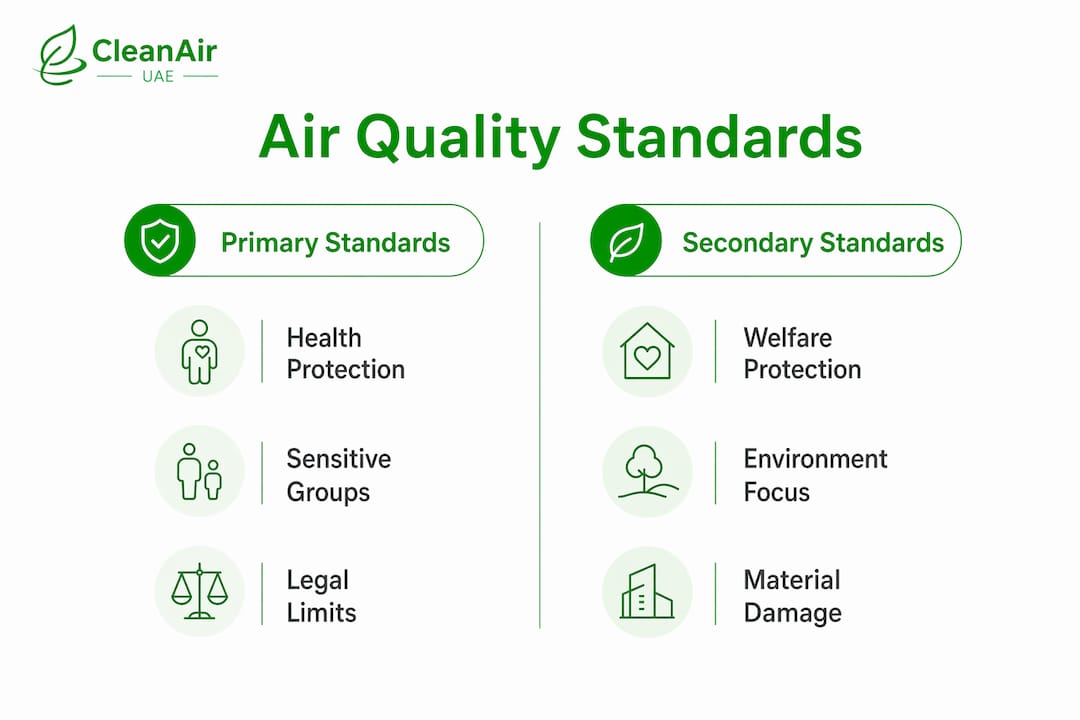
Standards split into two categories. Primary standards protect human health, including sensitive groups such as children and people with asthma. Secondary standards protect public welfare: crops, buildings, visibility, and ecosystems. Both types are grounded in scientific evidence and adopted by regulatory authorities such as DEFRA and the World Health Organization.
What is the scientific basis for air quality standards?
The WHO Global Air Quality Guidelines (updated in 2021) set the scientific foundation. They define evidence-based pollutant limits, including PM2.5 and PM10 guideline levels derived from systematic reviews of health outcome data. Only evidence assessed as having high or moderate certainty was used to set these levels.
Key points from the WHO framework:
- Guidelines cover PM2.5, PM10, NO2, O3, SO2, and CO for relevant averaging periods.
- Interim targets guide phased improvements for countries that substantially exceed guideline levels, acknowledging technical and economic constraints.
- Both chronic (long-term) and acute (short-term peak) exposures are addressed.
- WHO guidelines are not legally binding, but governments use them as a reference to set national standards.
Meeting a national standard means regulatory compliance. It does not guarantee zero health risk, because standards also weigh economic and technical feasibility against pure health science.
How does UK law regulate air quality?
The UK Air Quality Standards Regulations 2010 provide the statutory framework. They set legally binding concentration limits for key pollutants and place compliance obligations on local authorities and DEFRA. Monitoring networks must report publicly, and local authorities must produce Air Quality Action Plans where limits are breached.
Key features of the UK framework:
- Legally binding limits cover NO2, PM2.5, PM10, SO2, CO, benzene, and lead.
- DEFRA oversees national compliance and coordinates with the Environment Agency.
- Local authorities carry out air quality measurement through automatic monitoring stations and diffusion tube networks.
- Post-Brexit, the UK retained EU-derived limits through the Regulations, though future divergence remains possible.
- Public reporting obligations mean annual data is published via the UK-AIR portal.
The Regulations distinguish primary health-based limits from secondary welfare standards, mirroring the structure used in EU and US frameworks.

How do EU directives and WHO guidelines shape UK standards?
The EU 2008 Air Quality Directive established binding limit values that directly shaped the UK’s 2010 Regulations. For example, the EU set an annual mean limit of 40 µg/m³ for NO2 and a 24-hour limit of 50 µg/m³ for PM10, permitted to be exceeded no more than 35 times per year. These figures carried over into UK law.
Distinctions worth noting:
- EU limit values are legally binding from the date they enter into force.
- EU target values require all necessary measures not entailing disproportionate costs, making them less strict than limit values.
- WHO guideline levels are non-binding but serve as benchmarks. Countries often adopt less strict national standards that balance health benefits against economic feasibility.
- The WHO’s 5 µg/m³ annual mean for PM2.5 is considerably stricter than the EU’s former 25 µg/m³ limit value, illustrating the gap between advisory guidance and enforceable law.
Post-Brexit, the UK is no longer bound by new EU directives, but the 2010 Regulations remain in force and the political pressure to align with WHO 2021 guidelines continues to grow.
Why do averaging periods matter in pollution measurement?
Pollutant concentrations are expressed in micrograms per cubic metre (µg/m³) or parts per million (ppm), averaged over a defined period. The choice of averaging period reflects the type of health effect being controlled.
- 1-hour averages capture acute peaks, relevant for SO2 and NO2, where short bursts cause immediate respiratory irritation.
- 24-hour averages apply to PM2.5 and PM10, where a single day of high exposure can trigger hospital admissions.
- Annual means address chronic exposure, the driver of long-term cardiovascular and respiratory disease.
Acute effects relate to short-term peaks; chronic effects to long-term exposure, which is why the same pollutant can carry more than one standard with different averaging periods. NO2, for instance, has both a 1-hour limit and an annual mean limit under EU and UK law.
Pro Tip: A single “good” air quality reading tells you very little. If the long-term annual mean exceeds health-protective thresholds, short-term clean spells do not offset the cumulative exposure risk.
What happens when air quality standards are exceeded?
Exceeding air quality standards is directly linked to increased hospitalisations, worsening asthma, premature mortality, and higher rates of cardiovascular and respiratory disease. The health burden falls hardest on children, elderly people, and those with pre-existing lung or heart conditions.
Secondary impacts extend beyond human health:
- Elevated ozone damages agricultural crops and reduces yields.
- SO2 and nitrogen compounds corrode buildings and degrade materials.
- Particulate matter reduces visibility, affecting transport safety.
- Ecosystems suffer from nitrogen deposition, altering soil chemistry and biodiversity.
Understanding PM2.5 pollution is particularly relevant here. Fine particles penetrate deep into lung tissue and enter the bloodstream, making them the pollutant most strongly associated with premature death from air pollution exposure.
How have air quality standards evolved over time?
Air quality regulation has a longer history than most people realise. California enacted legislation requiring air quality standards as early as 1959, predating the US EPA’s formation in 1970. The US Clean Air Act Amendments of 1970 then mandated national primary and secondary ambient air quality standards, establishing the framework still in use today.
In the UK, the 1956 Clean Air Act responded directly to the 1952 Great Smog of London, which caused thousands of deaths and forced the first serious domestic air quality legislation. EU-level coordination followed decades later, culminating in the 2008 Air Quality Directive. The WHO has issued health-based guidelines periodically since 1987, with the most recent update in 2021 significantly tightening recommended levels based on accumulated evidence about chronic disease. Standards are not static: the US EPA is legally required to review its national standards periodically, and the California Air Resources Board has revised its own state standards multiple times as new health evidence emerged.
How do UK standards compare with those in other countries?
The WHO maintains a global database of national air quality standards, compiled with the Swiss Tropical and Public Health Institute, that maps how countries’ limits compare with WHO guideline levels. The picture is uneven.
The UK’s annual mean limit for NO2 matches the former EU standard, with WHO 2021 guidelines recommending much stricter levels. Other countries have standards that vary around these levels, reflecting different regulatory approaches. These differences reflect varying political, economic, and technical contexts rather than disagreement about the underlying health science.
What makes enforcing air quality standards difficult?
Enforcement is complicated by the fact that air does not respect administrative boundaries. Pollution generated in one local authority area routinely affects air quality in neighbouring areas, making accountability difficult to assign. Transboundary pollution from continental Europe contributes to UK exceedances of ozone and particulate matter on high-pollution days, factors entirely outside local control.
Monitoring coverage is uneven. Urban centres typically have dense networks of automatic monitoring stations, while rural and suburban areas rely more heavily on passive diffusion tubes, which provide monthly averages rather than hourly data. Legal action against local authorities for persistent breaches is possible but slow, and the gap between measured exceedance and actual enforcement action has historically been wide. The UK government’s Environment Act 2021 introduced new legally binding targets for PM2.5, but the mechanisms for achieving them remain under development.
How do air quality standards shape urban planning and public policy?
Air quality standards directly influence where roads, industrial sites, and housing developments can be built. Planning applications in the UK must include air quality assessments when a proposed development sits in or near an Air Quality Management Area, a zone declared by a local authority where standards are being breached. Developers may be required to fund mitigation measures or redesign schemes to reduce emissions.
At the policy level, standards drive low-emission zone designations, vehicle emission regulations, and public transport investment decisions. London’s Ultra Low Emission Zone was introduced specifically to reduce NO2 and PM concentrations in areas persistently exceeding legal limits. Standards also underpin clean air policies at the national level, from boiler efficiency requirements to agricultural ammonia controls. Without legally binding benchmarks, these policy levers would lack a clear trigger for action.
Key takeaways
UK air quality standards are legally binding concentration limits for six key pollutants, rooted in WHO scientific guidelines, enforced by DEFRA and local authorities, and directly linked to measurable public health outcomes.
| Point | Details |
|---|---|
| Primary vs secondary standards | Primary standards protect human health; secondary standards protect crops, buildings, and ecosystems. |
| WHO guideline for PM2.5 | The WHO recommends an annual mean of 5 µg/m³ for PM2.5, stricter than most national legal limits. |
| Averaging periods matter | The same pollutant can carry a 1-hour limit and an annual mean limit, each targeting different health effects. |
| UK legal framework | The UK Air Quality Standards Regulations 2010 set binding limits enforced by DEFRA and local authorities. |
| Standards inform planning | Air quality assessments are required for developments near Air Quality Management Areas in the UK. |
If outdoor air quality standards concern you, indoor air quality deserves equal attention. Cleanair-ae offers an air purifier buying guide for 2026 and a curated range of air purifier alternatives to help you manage the air inside your home or workplace.